Living as a faithful Catholic in 2025 can feel like walking through a minefield of moral gray areas. You want to follow God and stay true to the Church, but the modern world moves faster than a Sunday homily. You open your phone and see trends that the Apostles never had to deal with: mindfulness apps based on Eastern spirituality, friends getting meaningful tattoos, or the legalization of marijuana in your state.
It is natural to feel confused. The Bible does not explicitly mention “yoga studios” or “online sports betting,” and you won’t find a chapter in the Catechism dedicated to “cryptocurrency trading.” This lack of specific direction often leads to scrupulosity — the fear that you are sinning when you aren’t — or, conversely, drifting away from grace without realizing it.
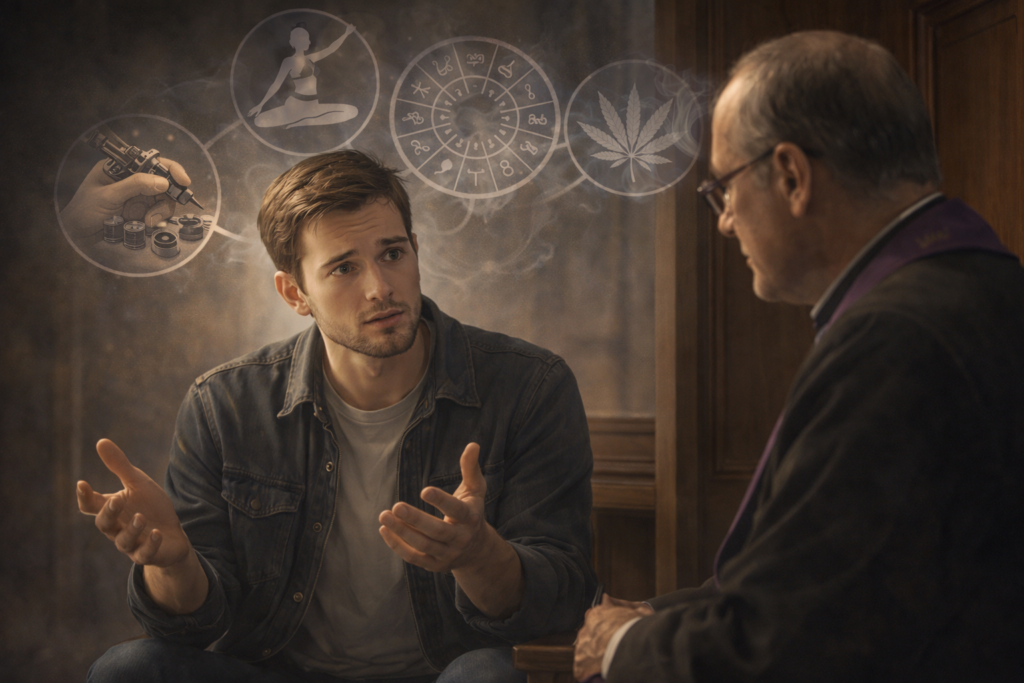
This guide is designed to bridge the gap between ancient faith and modern life. We have gathered the most common questions Catholics ask about contemporary morality and provided clear, direct answers based on Scripture and Church teaching. Whether you are wondering about the spiritual risks of your workout routine or how to handle a difficult living situation, you will find clarity here.
For a broader look at maintaining your faith daily, you might also want to read our guide on How to Live a Catholic Life in the Modern World. But for now, let’s tackle those specific burning questions.
The Short Answer: The Catholic Church does not explicitly forbid the physical movements (stretching and posing) associated with yoga. However, it strongly cautions against the spiritual philosophy of yoga, which is rooted in Hinduism. If you practice yoga solely for fitness, it is generally permissible, but if you engage in the chanting, meditation, or spiritual “opening of chakras,” it becomes incompatible with Catholic faith.
Many Catholics attend yoga classes strictly for flexibility and stress relief, ignoring the spiritual background. While the intent matters, it is crucial to understand the risks involved.
The word “yoga” literally means “yoke” or “union” in Sanskrit — specifically, union with the divine (Brahman) in Hindu theology. Many poses (asanas) are originally designed as physical acts of worship to specific deities.
The Church has addressed this specific issue. In the Letter to the Bishops of the Catholic Church on Some Aspects of Christian Meditation (1989), the Congregation for the Doctrine of the Faith warns that mixing Christian prayer with Eastern techniques can lead to “syncretism” — a confusion of beliefs where the unique role of Christ is lost.
You can read the full document on the official Vatican website here. The key takeaway is that we should not seek “enlightenment” through technique, but rather salvation through a relationship with Jesus Christ.
If you love the physical benefits of yoga but feel uncomfortable with the spiritual baggage, you don’t have to give it up entirely. several Catholic ministries have reclaimed these movements:
Still unsure about your specific class? If your local studio feels too spiritual or you are worried about the “energy work” they are teaching, trust your gut.
Need advice on your specific situation? Describe your yoga class to our AI Priest and get a clear perspective on whether it aligns with your faith.

The Short Answer: The Catholic Church does not forbid tattoos. Unlike some fundamentalist Christian denominations, Catholicism does not view getting a tattoo as intrinsically sinful. However, the morality of a tattoo depends entirely on what image you choose, where you place it, and why you are getting it.
This is the most common argument against tattoos. The verse states: “You shall not make any cuttings in your flesh for the dead, nor tattoo any marks on you: I am the Lord.” (Leviticus 19:28).
However, sound Catholic biblical interpretation requires context:
St. Paul writes, “Do you not know that your body is a temple of the Holy Spirit?” (1 Corinthians 6:19). Some argue that tattoos “graffiti” this temple. The Catholic counter-argument is that temples are often decorated with beautiful art (stained glass, frescoes). A tattoo can be a form of art or a permanent testimony of faith (like a cross, a saint, or a scripture verse). The red line is crossed when the modification becomes “mutilation” — something that disfigures the body or dishonors its God-given dignity.
While the act of tattooing isn’t a sin, the content can be. You should avoid:
Even if an image is “clean,” you must exercise the virtue of prudence. Ask yourself:
Thinking about getting inked? If you are unsure if a specific design or location is appropriate for a Catholic, you can get an unbiased, confidential opinion. Chat with a Priest to discuss your motivations and ensure your decision honors God.
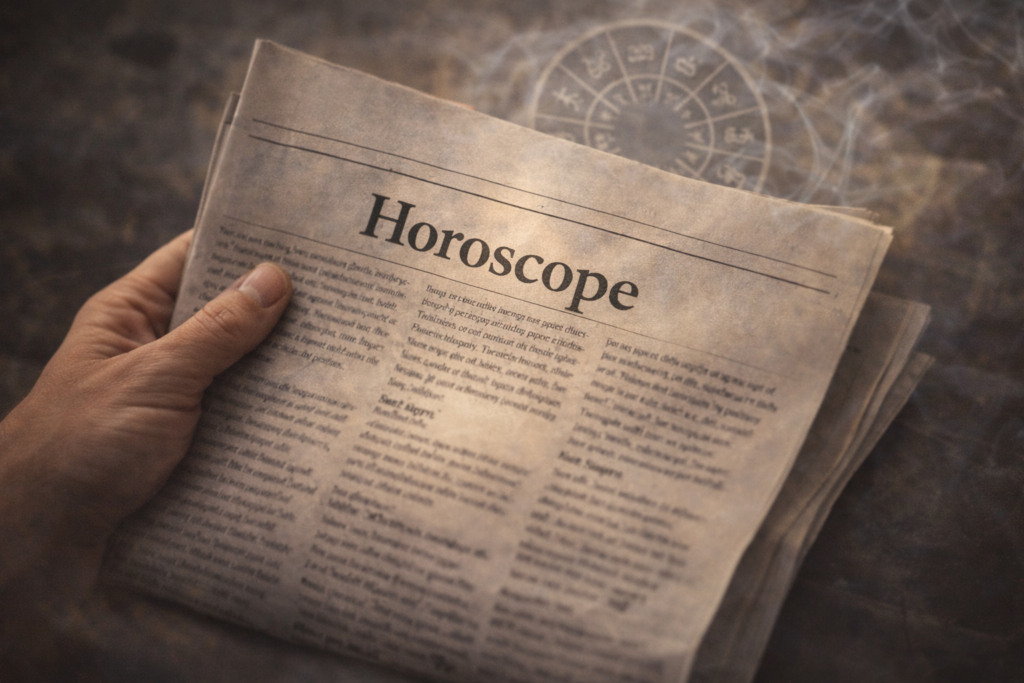
The Short Answer: Yes. The Catholic Church strictly forbids the practice of astrology, horoscopes, and consulting psychics. While it might seem like harmless entertainment, relying on the stars or mediums to predict the future is considered a grave sin against the First Commandment (“I am the Lord your God; you shall not have strange gods before me”).
The core issue isn’t just about planets or cards; it is about trust. When we turn to horoscopes, we are essentially saying that we do not trust God’s plan for our future and want to seize control of it ourselves.
The Catechism of the Catholic Church is very clear on this matter. Paragraph CCC 2116 states that all forms of divination are to be rejected. This includes:
You can read the full text of the Catechism on this topic on the official USCCB website here.
The Church teaches that these practices conceal a desire for power over time, history, and other human beings. They contradict the honor, respect, and loving fear that we owe to God alone.
Many Catholics ask: “I don’t actually believe it, I just read it for fun in the newspaper. Is that a sin?”
While glancing at a horoscope out of curiosity might not be a mortal sin (if you truly don’t believe it), it is spiritually dangerous territory. It is often called a “slippery slope.”
A Note on “Manifestation”: The modern trend of “manifesting” (using your mind to attract success) is often a rebranded form of New Age superstition. Catholics do not “manifest” outcomes; we pray to a loving Father who knows what we need, adding “Thy will be done,” not “My will be done.”
Have you been relying on horoscopes? If you feel like you have replaced your trust in God with superstition, or if you are worried you may have committed a serious sin by visiting a psychic, don’t panic. Talk to a Priest Online right now to discuss how to renounce these practices and find peace in God’s plan again.
The Short Answer: Yes. The Catholic Church teaches that living together more uxorio (like husband and wife) before marriage is objectively sinful. This is primarily because it usually involves premarital sex (fornication), which violates the Sixth Commandment. Even if a couple is not having sex, living together can cause “scandal” — meaning it confuses others about the sanctity of marriage and creates a near occasion of sin.
A common modern argument is: “We need to live together to see if we are compatible before we sign the papers.” While this sounds logical to the secular world, it contradicts the very nature of Catholic marriage.
If you are reading this and currently living with your boyfriend or girlfriend, do not despair. The Church wants to help you get to the altar, not chase you away. Here is the path usually recommended by priests:
Is your living situation complicated? Perhaps you want to get married in the Church but are afraid to approach your local priest because you are already living together. You can discuss your specific circumstances anonymously first. Talk to a Priest Online to get advice on how to prepare for a holy marriage from where you are right now.
The Short Answer: Yes, the Catholic Church has permitted cremation since 1963, provided it is not chosen for reasons contrary to Christian doctrine (like a denial of the resurrection of the body). However, the Church has strict rules on what must be done with the ashes afterwards. You cannot treat the remains as a souvenir or scatter them in nature.
In 2016, the Vatican issued an instruction called Ad Resurgendum cum Christo, clarifying exactly how Catholics must handle cremated remains. The key principle is that the ashes must be treated with the same respect and dignity as a physical body.
It is forbidden to scatter ashes in the air, on land, at sea, or in some other way.
No. The Church teaches that ashes should not be kept in a private home, nor should they be divided among family members or preserved in jewelry (lockets).
The ashes must be laid to rest in a sacred place, such as a cemetery grave or a columbarium (a niche in a church or cemetery wall). This ensures that the deceased is not forgotten and is prayed for by the entire Christian community.

The Short Answer: The Catholic Church teaches that alcohol is a gift from God (Jesus Himself turned water into wine), but it must be used with the virtue of temperance. “Getting drunk” is a sin because it deprives you of your reason. Regarding marijuana, the Church distinguishes between strictly therapeutic (medical) use and recreational use.
Alcohol itself is not evil. The sin lies in the excess. The Catechism teaches that the virtue of temperance disposes us to avoid every kind of excess: the abuse of food, alcohol, tobacco, or medicine.
With the legalization of cannabis in many places, confusion has grown.
Struggling with Substance Use? If you find that you cannot stop at one drink, or if you are using substances to escape reality, this may be a spiritual and medical battle. Read our guide on Catholic Addiction Support Online to find resources and prayers for breaking these chains.
The Short Answer: Gambling (betting on sports, playing cards for money, or buying lottery tickets) is not intrinsically evil. Unlike stealing or lying, the act itself is neutral. However, it becomes morally unacceptable when it deprives you of what is necessary to provide for your needs and those of others.
The Catechism teaches that games of chance are legitimate forms of recreation. But the line between a hobby and a sin is crossed when the virtue of justice is violated.
Gambling becomes a sin when it enslaves you. If you feel a compulsion to bet that you cannot control, or if you are lying to cover up your losses, you have moved from recreation to spiritual bondage.
Every dollar you have is a gift from God to be used wisely.
The Short Answer: Not every sin breaks your relationship with God entirely. The Church distinguishes between venial sin (which wounds charity) and mortal sin (which destroys it). If you are reading this guide and worrying about your past actions, use this checklist.
For a sin to be “mortal” (requiring Confession before receiving Communion), all three of the following conditions must be met together:
If you look at the list above and think, “I knew it was wrong, but I did it anyway,” do not lose hope. This guilt is actually a grace — it is your conscience calling you back home. The remedy is simple and powerful: the Sacrament of Reconciliation.
Ready to clean the slate? Read our step-by-step guide on How to Prepare for Confession to find an examination of conscience that will help you make a good confession.
Living a Catholic life in 2025 isn’t about memorizing a list of forbidden activities. It is about aligning your heart with God. The rules of the Church are not there to restrict you, but to protect you — like guardrails on a steep mountain road. They keep you safe from spiritual harm so you can reach your destination: Heaven.
We hope this guide has cleared up the confusion around yoga, tattoos, and other modern dilemmas. Remember, Christianity is not a religion of fear, but of love.
Still have questions? Life is complicated, and every situation is unique. If you are struggling with a specific moral dilemma that wasn’t covered here, or if you need to talk to someone immediately but feel ashamed to go to your parish priest yet, help is available.
Talk to a Priest Online Now Start an anonymous, confidential conversation with our AI Priest. Get the spiritual guidance you need, anytime, day or night.