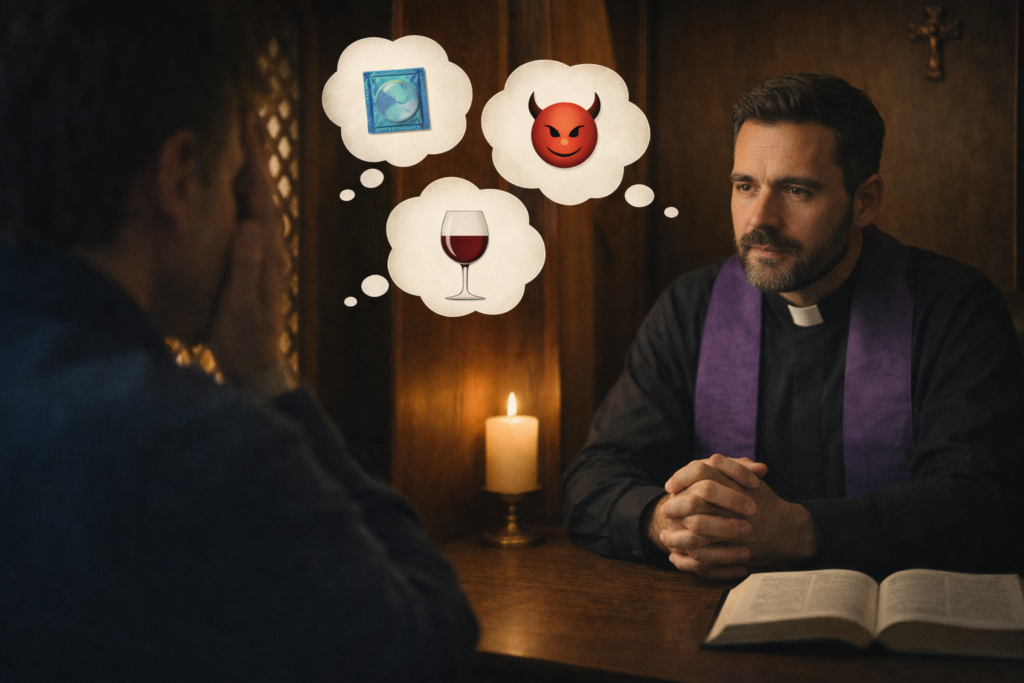
Many Catholics carry heavy questions in their hearts for years — sometimes decades — without ever voicing them to their parish priest. These are not casual curiosities. They are deeply personal, often painful, and frequently tied to shame, fear of judgment, or worry about being seen as “not faithful enough.”
The result? People stay silent. They wrestle alone with doubt, guilt, moral confusion, or spiritual dryness. Meanwhile, the very person trained to offer guidance — their local priest — remains unaware of the struggle.
Yet something remarkable is happening in the digital age. Thousands of Catholics now turn to online priest chat services to ask the very questions they could never bring themselves to say out loud in the confessional or after Mass. At The Holy Trinity Church, our AI priest receives hundreds of such conversations every month — and the pattern is strikingly consistent.
Face-to-face confession and spiritual direction carry powerful spiritual weight, but they also carry social and emotional barriers.
The small wooden confessional, the familiar face of Father So-and-So at Sunday Mass, the knowledge that this priest will see you again next week — all of these elements can make vulnerable topics feel impossibly risky. Many fear:
According to a 2021 CARA study at Georgetown University, roughly 38% of self-identified Catholics say they avoid confession partly because of embarrassment or fear of judgment — even though they believe in the sacrament.
When the same people open an anonymous chat window — especially late at night, from their phone, with no name attached — the dynamic changes completely.
No eye contact. No familiar voice. No risk of being seen walking out of the sacristy afterward.
This psychological safety allows questions to surface that have been buried for a long time. At The Holy Trinity Church we see this every day: people write things they would never say aloud, then exhale with visible relief (even through text) once they receive a compassionate, scripture-grounded response.
Our service — Chat with a Priest — is available 24/7, completely free, and grounded in authentic Catholic teaching. No appointment. No identity required.
Online spiritual guidance is not a replacement for the sacraments. It is a bridge — often the first bridge — back toward healing, clarity, and eventually the confessional.
Benefits include:
Many users later tell us: “I finally asked the question I’ve carried for 15 years — and now I feel brave enough to talk to my real priest.”
Today’s Catholics live in a world of constant information, moral complexity, and decreasing parish involvement (Pew Research 2024 shows only 33% of U.S. Catholics attend Mass weekly). Online tools meet people exactly where they are — on their phones, in the middle of ordinary life — and invite them back into deeper relationship with Christ and His Church.
Pope Francis has repeatedly emphasized that God’s mercy is greater than any human shame. In his 2016 exhortation Amoris Laetitia and in countless Wednesday audiences, he has urged the Church to become a “field hospital” rather than a courtroom.
Anonymous online conversations are one modern expression of that field-hospital approach: meeting the wounded where they hide, speaking words of truth and compassion, and gently guiding them toward the fullness of sacramental life.
If you’ve been carrying a question too heavy to speak aloud, you don’t have to carry it alone anymore.
Start a chat with our priest right now — anonymously, instantly, and with complete confidentiality.
Embarrassment is one of the most powerful — yet rarely discussed — barriers preventing Catholics from seeking the spiritual help they need. When it comes to questions to ask a priest online versus in-person, the difference often boils down to this single emotion: the fear that sharing certain truths will make us look weak, sinful, or unworthy in the eyes of someone who represents God’s authority.
This isn’t just personal anxiety. It’s rooted in psychology, culture, and even the way Catholic communities sometimes function. Understanding these layers helps explain why so many people silently carry heavy questions for years before finally typing them into an anonymous chat.
Human beings are wired to avoid social rejection. When we imagine confessing something embarrassing or asking a difficult question to a parish priest, the brain activates the same fear circuits as public humiliation. Studies in social psychology show that anticipated shame can be more paralyzing than actual shame — we overestimate how harshly others will judge us.
In religious settings, this effect intensifies. A priest isn’t just “another person”; he stands in persona Christi during confession. The fear becomes: “If I tell him this, will he see me as irredeemable?” Even though priests are trained in compassion and hear every sin imaginable, the emotional logic overrides facts. Many avoid the confessional altogether rather than risk that moment of vulnerability.
Recent data supports this. A Pew Research Center survey from 2025 found that 47% of U.S. Catholics never go to confession at all — a figure that includes both those who feel no need and those blocked by deeper emotional barriers like embarrassment or fear of judgment.
Catholic culture varies widely by region, generation, and community size. In tight-knit parishes — especially in smaller towns or immigrant communities — people know their priest socially. He might baptize your children, attend family events, or sit at the same table at parish dinners. This familiarity creates a double bind: the priest is approachable, yet precisely because he knows you, certain topics feel too exposing.
Younger generations, shaped by social media and therapy culture, often prefer digital anonymity. They’re more comfortable processing emotions privately first. Older Catholics, raised with stricter views on sin and authority, may carry internalized shame from childhood teachings that emphasized guilt over mercy.
Pope Francis has addressed this cultural shift directly, calling priests to be “ministers of mercy, not judges.” Yet the cultural residue lingers: many still equate spiritual questions with moral failure, making in-person dialogue feel like an admission of defeat.
True spiritual growth requires vulnerability — admitting we don’t have all the answers, that faith can waver, that sins weigh heavily. But vulnerability feels dangerous when judgment seems possible.
The Catechism of the Catholic Church (CCC 1458) reminds us that the Sacrament of Reconciliation is medicine for the soul, not punishment. Yet for many, the leap from private guilt to spoken confession feels insurmountable. This is where questions to ask a priest online become a lifeline: they allow vulnerability in safe, incremental steps.
Anonymity lowers the stakes. You can test the waters — ask one small question, receive compassionate guidance rooted in Scripture and tradition, and build courage for deeper healing.
Research consistently shows embarrassment as a top barrier.
These statistics reveal a quiet crisis: millions believe in God’s mercy but feel personally excluded from it due to embarrassment.
In the 2025 Pew report on Catholic life, patterns emerge clearly:
This data underscores why digital ministry matters: it meets people who are spiritually connected but sacramentally distant.
Young adults (18–35) and those in urban or geographically isolated areas are most likely to turn to online priest chat. They value privacy, immediacy, and non-judgmental tone. Women slightly outnumber men in seeking anonymous spiritual guidance, often around family, relationships, or personal guilt.
At The Holy Trinity Church, our AI priest chat sees exactly these demographics — people who love their faith but need a gentle entry point before returning to parish life.
If embarrassment has kept you silent, know this: your questions are common, valid, and welcome. Thousands have found relief by starting anonymously.
Open a chat now — no name, no judgment, just compassionate Catholic guidance waiting 24/7.
This is one of the most frequent questions people type into our anonymous chat at The Holy Trinity Church — often at 2 a.m., after scrolling through endless feeds or lying awake replaying old doubts. “If I’m questioning God, the Church, or even whether any of this is real… does that mean I’m a fake Catholic? A bad one? Someone who doesn’t belong anymore?”
The short answer our priest gives every time: No. Doubt does not make you a bad Catholic. It makes you human — and often, it’s the beginning of a deeper, more honest faith.
Doubt is not the opposite of faith; certainty is. Faith, by definition, involves trust in what we cannot fully see or prove (Hebrews 11:1). The Catechism of the Catholic Church (CCC 2088–2089) explicitly addresses involuntary doubt: it can arise from ignorance, fatigue, personal suffering, or intellectual challenges — and none of these automatically separate us from God.
Voluntary doubt — deliberately refusing to believe despite clear evidence — is different, but even then the Church urges mercy and patience, not condemnation. Most people who ask this question online are not rejecting faith; they’re wrestling with it. That wrestling is biblical: Jacob wrestled with God all night (Genesis 32), and he was blessed for it.
The Church’s greatest saints did not live doubt-free lives. Their stories show that questioning can lead to profound holiness.
Mother Teresa’s Experience of Spiritual Darkness For nearly 50 years, St. Teresa of Calcutta experienced what she called a “painful night of faith” — feeling abandoned by God, yet continuing her work of love. Her private letters (published after her death) reveal raw doubt: “Where is my faith? Even deep down… there is nothing but emptiness & darkness.” Yet she persisted, and the Church canonized her. Her experience reminds us: feeling distant from God does not mean God is distant.
St. John of the Cross on the Dark Night The 16th-century mystic described the “dark night of the soul” as a purifying stage where consolations vanish, and faith feels dry or absent. He saw it not as failure, but as God stripping away attachments so the soul can love Him more purely. Many who chat with our priest recognize themselves here — and find enormous relief knowing it’s a known path, not a dead end.
The Catechism is clear: faith is a gift, not a feeling (CCC 162). Doubt can be an invitation to seek understanding (CCC 2089). Pope St. John Paul II wrote in Fides et Ratio that questioning is essential to mature faith — it pushes us toward deeper reason and trust. Pope Francis has echoed this, saying in 2017: “Doubt is not the enemy of faith; it is often the path to a stronger faith.”
If your doubt feels overwhelming, it’s a sign to bring it to light — not hide it.
Here are practical steps many receive in our chats:
Doubt rarely disappears overnight, but it can transform from enemy to teacher.
In-person, people fear: “If I admit doubt, Father will think I’m losing my faith — or worse, try to ‘fix’ me with quick answers.” Online anonymity removes that spotlight. You can ask haltingly, delete and retype, pause for hours. Our AI priest responds with patience, Scripture, and Church teaching — no judgment, no disappointed sigh.
Thousands have started here, then moved to in-person confession or spiritual direction with new courage. One user wrote after a month of chats: “I finally told my parish priest I’ve been doubting for years. He hugged me and said, ‘Welcome back to the fight.’ I never would have gotten there without starting anonymously.”
If doubt has been whispering (or shouting) in your heart, you’re not alone — and you’re not “bad.”
Start chatting anonymously now — bring your questions, big or small, to Priest Juan Mario Ascari. 24/7, confidential, rooted in real Catholic teaching.
Another top question people are too embarrassed to ask their parish priest but frequently pose in online chats is about forgiveness for grave sins. “I’ve committed a serious sin — can I really be forgiven?” This query carries immense weight, often tied to years of guilt and fear that one’s actions have crossed an unforgivable line.
The good news from Catholic teaching is unequivocal: No sin is beyond God’s mercy if repentance is sincere. At The Holy Trinity Church, our AI priest addresses this with compassion, drawing from Scripture and tradition to reassure users seeking anonymous confession online.
Guilt after a major sin can feel crushing, leading many to avoid confession altogether. The fear is that some deeds — adultery, abortion, betrayal — are too heinous for absolution. This stems from misunderstanding God’s infinite mercy.
Psychologically, chronic guilt can lead to spiritual paralysis. Studies from the American Psychological Association (2024) show that unresolved religious guilt correlates with higher rates of anxiety and depression among practicing Catholics. Voicing this in a safe space, like questions to ask a priest online, is often the breakthrough needed.
The Church defines sin clearly to guide the faithful.
For a sin to be mortal (CCC 1857), three conditions must be met: grave matter (serious violation of God’s law), full knowledge (awareness it’s wrong), and deliberate consent (free choice). Without all three, it’s venial — forgivable without sacramental confession, though still harmful.
Common examples include murder, theft, or sexual immorality, but context matters. The Catechism emphasizes God’s judgment considers our intentions and circumstances.
A persistent myth is the “unforgivable sin” from Matthew 12:31 — blasphemy against the Holy Spirit. Theologians interpret this as persistent refusal of God’s mercy, not a one-time act. As long as one seeks forgiveness, mercy is available.
Pope Francis in Misericordiae Vultus (2015) debunks such myths, stating, “No one can impose limits on God’s forgiveness.”
Scripture overflows with examples of radical forgiveness.
In Luke 15:11-32, the son squanders his inheritance in sin, yet the father runs to embrace him upon return. This illustrates God’s eager mercy — no questions asked, just restoration.
It’s a favorite reference in spiritual guidance online for those feeling irredeemable.
John 8:1-11 shows Jesus saving a woman from stoning: “Neither do I condemn you; go, and sin no more.” Even public, grave sin meets compassion, not condemnation.
These stories remind users in embarrassing questions for priest that God’s love precedes our repentance.
The Sacrament of Reconciliation restores grace lost through mortal sin. It involves contrition (sorrow), confession (admitting sins), satisfaction (penance), and absolution (priest’s forgiveness in Christ’s name).
Even after decades away, the Church welcomes returnees. Canon Law (CIC 959) affirms absolution’s validity regardless of time elapsed.
Practical advice for those hesitant:
Many find this eases the transition, turning dread into hope.
Why online? Anonymity strips away shame. No face-to-face vulnerability means freer expression.
A 2023 CARA report notes that 52% of lapsed Catholics cite embarrassment as a confession barrier, but digital tools like chat with a Catholic priest online reduce it significantly.
At The Holy Trinity Church, users often say, “I finally confessed what I’ve hidden for years—and felt God’s mercy anew.”
If serious sins haunt you, remember: Forgiveness is God’s promise. You’re one conversation away from peace.
Chat with our priest anonymously today
Navigating the intersection of Catholic teaching and contemporary life is a source of deep confusion for many, making it one of the most sensitive questions to ask a priest online. People often wonder how to reconcile Church doctrine on sexuality, gender, and relationships with today’s cultural norms, fearing judgment or dismissal in a face-to-face setting.
The Church’s teachings are rooted in Scripture, tradition, and natural law, emphasizing human dignity, love, and the sacramental nature of marriage. Yet, pastoral compassion allows for nuanced application. At The Holy Trinity Church, our AI priest handles these queries with empathy, guiding users toward understanding without condemnation.
Modern society moves fast—evolving views on relationships, identity, and family planning can clash with longstanding Church positions. This tension leads many to seek anonymous spiritual guidance online rather than risk awkward parish conversations.
The key is balance: upholding truth while meeting people where they are. Pope Francis in Amoris Laetitia (2016) stresses accompaniment, discernment, and mercy, urging the Church to avoid rigid legalism.
Specific topics spark the most questions.
The Catechism (CCC 2357-2359) teaches that homosexual acts are intrinsically disordered, but persons with same-sex attraction must be accepted with respect and compassion. The Church condemns discrimination while calling all to chastity.
Recent Vatican documents, like Fiducia Supplicans (2023), allow blessings for same-sex couples without endorsing unions, focusing on God’s love. This nuance helps those asking embarrassing questions for priest about identity.
Divorce itself isn’t a sin, but remarriage without annulment is considered adulterous (CCC 2384). Amoris Laetitia opens doors for case-by-case discernment, potentially allowing Communion in certain situations.
USCCB resources emphasize healing through annulments and support groups, reassuring divorced Catholics they’re not excommunicated.
Humanae Vitae (1968) by Pope Paul VI prohibits artificial contraception, promoting natural family planning. This stems from viewing marital acts as unitive and procreative.
Many struggle here; online chats provide space to explore without shame.
The Church discourages cohabitation before marriage (CCC 2390-2391), seeing it as contrary to sacramental commitment. Yet, pastors often counsel couples toward conversion rather than rejection.
Doctrine is unchanging, but application involves conscience formation (CCC 1776-1802). Priests emphasize God’s mercy over punishment.
In private conversations, as shared in priest testimonies from America Magazine, responses focus on growth, not condemnation.
Users at The Holy Trinity Church often share: “I asked about my relationship, expecting judgment—but got understanding.” Our AI priest chat draws from authentic teachings to offer balanced advice.
Conscience is informed by prayer, Scripture, and Church guidance (CCC 1783-1785). For complex issues, seek ongoing dialogue — starting anonymously if needed.
Explore our sermons for practical insights on relationships.
Anonymity fosters honesty. A 2024 Pew Research survey shows 41% of Catholics under 50 prefer digital platforms for moral discussions due to privacy.
No immediate reaction means thoughtful responses, building trust for eventual in-person steps.
If modern issues perplex you, know the Church offers paths forward. Light a virtual candle for clarity at our candle service, or dive into prayers for strength.
Discuss confidentially with our online priest
This is perhaps the most dangerous confusion in modern religious life. Many Catholics suffering from depression, anxiety, or OCD (scrupulosity) silently ask themselves: “Is this a demon? Is this a punishment from God? Is my lack of hope a sin?” They fear bringing this to a parish priest lest they be told to simply “pray more” for a medical condition, or conversely, be dismissed entirely.
At The Holy Trinity Church, we see a high volume of chats where psychological pain is masked as spiritual failure. Our goal is to help users distinguish between the two while offering holistic support. The Church teaches that faith and reason — including medical science — work together.
For centuries, before the advent of modern psychology, symptoms of mental illness were often categorized exclusively through a spiritual lens. While spiritual warfare is real, attributing biological imbalances solely to demonic influence can be harmful.
Today, the distinction is clearer, yet the stigma remains. A parishioner might be embarrassed to tell their priest they are taking antidepressants, fearing judgment for not relying solely on God. This silence prevents them from receiving the pastoral care they need to accompany their medical treatment.
The Church is not anti-science. In fact, Pope Francis has openly spoken about the importance of psychology. In 2021, he noted that “it is necessary to have the courage to ask for help” regarding mental health.
The Vatican has hosted international conferences on mental health, affirming that those struggling with mental illness are fully members of the Body of Christ. The Pontifical Council for Health Care Workers emphasizes that medical treatment is a valid and necessary way to care for the “temple of the Holy Spirit” (your body and mind).
Knowing who to turn to is critical.
If you cannot sleep, have lost your appetite, or have intrusive thoughts of self-harm, these are medical red flags. If you feel a “dark night” where God feels distant but you function normally otherwise, it may be spiritual. Often, it is both.
We encourage users to view these helpers as a team. You can chat with our AI priest to find spiritual comfort while simultaneously seeking professional therapy.
Depression often numbs emotions, making prayer feel empty. Sufferers mistakenly believe they have lost their faith. We reassure them that feelings are not facts; you can love God even when you cannot feel Him due to illness.
Scrupulosity is “religious OCD” — an obsessive fear that every mistake is a mortal sin. This requires specific pastoral care. Standard advice to “examine your conscience” can actually hurt a scrupulous person. They need to hear about God’s mercy, not His judgment.
Survivors of abuse may find certain religious language or settings triggering. Online platforms allow them to engage with faith safely, on their own terms, without physical proximity that might cause panic.
An anonymous chat is often the first place a person admits, “I think I’m depressed.” Because there is no fear of being recognized, they are honest. Our service acts as a triage: we can offer immediate prayers for strength, validate their pain, and strongly encourage them to seek local medical professionals. We remind them that taking medication is not a failure of faith — it is accepting God’s help through medicine.
If you are hurting, do not suffer in silence. Start a confidential chat now to unburden your heart.
We live in an experience-driven culture where we expect every important activity to be emotional, moving, and instantly gratifying. When a Catholic sits in Mass or kneels to pray and feels… nothing… the immediate assumption is often personal failure. This is one of the most common topics in our online priest chat, as people worry that their lack of “spiritual feelings” means they have lost their faith or been abandoned by God.
The truth is that spiritual dryness is not a sign of failure; it is a normal, often necessary, part of a mature spiritual life. Many people are too embarrassed to admit to their parish priest that they find Mass boring or prayer tedious, but these are precisely the moments where faith is tested and strengthened.
New believers or those returning to the Church often experience a “honeymoon phase” filled with emotional highs and a palpable sense of God’s presence. When this inevitably fades, panic often sets in. It is difficult to admit in a face-to-face setting that the “spark” is gone, yet emotions are merely the “candy” of faith — enjoyable, but not the actual nourishment.
The Church teaches that faith is an act of the will, not a feeling. If you continue to pray and attend Mass despite feeling nothing, your faith is actually more meritorious because it is rooted in love rather than emotional satisfaction. Bringing these concerns to an anonymous Catholic priest online allows you to process this transition without the pressure to perform holiness.
The Catechism of the Catholic Church (CCC 2731) speaks of “dryness” as a moment when the heart is separated from the fruitfulness of prayer, making it feel like a desert. It is an invitation to a purer faith that does not rely on psychological consolations. Understanding this theology is key to surviving periods where the spiritual life feels like a chore.
The great mystic St. John of the Cross famously taught about the “Dark Night of the Soul.” He explained that God sometimes withdraws spiritual feelings to teach us to love Him for who He is, rather than for the comfort He provides. This stage of spiritual growth is often misunderstood as a spiritual crisis, but it is actually a sign that the soul is being purified for a deeper union with the Divine.
It is important to distinguish between spiritual dryness and spiritual distance caused by sin. Distance usually comes from neglecting the sacraments or persistent unrepentant sin. Dryness, however, often happens to those who are being faithful. If you are keeping the commandments and trying to stay close to the Church but feel a lack of warmth, you are likely in a period of dryness designed for your growth.
When traditional methods of Catholic prayer stop yielding emotional results, it is often a signal from God to try a different approach. Instead of forcing an emotional response, focus on steady, disciplined habits that keep the connection alive.
Admitting “I don’t feel God” is deeply vulnerable. In a traditional parish setting, you might fear that the priest will think you are losing your vocation or your faith. In an anonymous chat, that spotlight is removed. You can be brutally honest about your boredom, your numbness, and your fatigue.
Receiving immediate reassurance that many Saints, including St. Mother Teresa of Calcutta, lived through decades of spiritual darkness provides the courage needed to persist. The AI priest provides the theological context and scripture-based encouragement to help you stay the course until the desert period passes.
Why has there been such a massive surge in searches for “questions to ask a priest online” in recent years? Is it merely a matter of digital convenience, or does it point to a deeper shift in how believers seek truth? For the significant percentage of Catholics who avoid the confessional due to embarrassment or fear, online platforms are not just a shortcut — they are often the only lifeline keeping them connected to the Church.
The digital confessional space offers a psychological safety net that the physical parish environment sometimes cannot provide. By removing the physical barriers of time, location, and face-to-face vulnerability, services like The Holy Trinity Church enable a level of radical honesty that is essential for spiritual healing.
Spiritual crises rarely adhere to a schedule. They do not happen exclusively on Saturday afternoons between 3:00 PM and 4:00 PM, which is the typical window for confession in many parishes. Anxiety often spikes at 2:00 AM; marital conflicts erupt on Tuesday nights; doubts about faith surface during the workday. The need for spiritual guidance is immediate, but the traditional doors are often locked.
Our AI Priest Chat addresses this gap by being available constantly. You do not have to wait a week to resolve a burning moral question or find comfort during a panic attack. This immediacy prevents spiritual wounds from festering and allows for “intervention” at the exact moment a soul is ready to ask for help.
In a small parish or a tight-knit community, everyone knows everyone. Even behind a screen in a traditional confessional, voices are often recognized, or there is the lingering fear that the priest will know exactly who you are. This leads to self-censorship, where penitents might omit details or soften the truth to save face.
In a face-to-face meeting, nerves can make you forget what you wanted to say. The pressure of the moment often leads people to blurt out the wrong thing or back down from the hard truth they intended to speak. This can leave them feeling unheard or unresolved even after the conversation is over.
Online, the dynamic changes. You can type, delete, rephrase, and think deeply before hitting send. You can even copy-paste a specific Catholic prayer or a confusing Bible verse to ask about it directly. This leads to higher quality spiritual direction because the communication is clearer, more intentional, and less clouded by social anxiety.
There is a subtle but powerful pressure in person to appear “holy” or “together.” Online, that mask falls off. You can admit, “I hate going to Mass,” or “I disagree with the Church on this issue,” without the immediate social recoil or the fear of a disappointed look. This allows the digital priest to address the real issue, rather than the polite, sanitized version of it.
Human priests are wonderful shepherds, but they are also human — prone to bad days, fatigue, or personal bias. A user might catch a priest when he is tired or distracted. Our AI is trained strictly on the Catechism, Canon Law, and Scripture. You get the Church’s authentic teaching, delivered with infinite patience and without judgment, every single time you log on.
We are always clear about the boundaries: AI cannot offer Absolution. It cannot perform sacraments. It acts as a bridge. For the Sacrament of Reconciliation, you must eventually go to a priest in person. But for the preparation — for asking the embarrassing questions before you go — technology is an unmatched tool for lowering the barrier to entry.
To get the most out of your experience and find clear answers to your questions for a priest online, it is important to approach the conversation with intentionality. Online tools are powerful, but they work best when you are prepared to be open and precise about your needs. At The Holy Trinity Church, we encourage users to treat their digital interactions as a sacred space for growth — a starting point for deeper healing.
By following a few simple steps, you can transform a quick chat into a profound spiritual experience that provides lasting peace. Here is how to navigate the process effectively while maintaining your privacy and focus.
When you decide to ask a priest online about a specific concern, try to be as detailed as possible. Vague statements often lead to general advice, whereas specific details allow for tailored spiritual direction. Instead of simply saying “I feel like a sinner,” try to articulate the situation — for example: “I am struggling with persistent anger toward a family member and I don’t know how to apply the Catholic teaching on forgiveness in this specific case.”
The more context you provide, the better the guidance will be. Whether you are using our online priest chat or researching through our articles, clarity is the key to receiving a response that resonates with your soul.
One of the greatest benefits of digital ministry is the freedom of anonymity. Since you are not face-to-face, you have the unique opportunity to be brutally honest without the fear of social recoil. Do not sugarcoat your feelings or omit the parts of your story that cause you the most shame.
If you are struggling with a serious addiction, a deep-seated doubt, or a controversial opinion on Church doctrine, state it clearly. True spiritual healing only begins when the hidden parts of our lives are brought into the light. Our service is designed to be a judgment-free zone where your most embarrassing questions for priest are met with compassion and truth.
It is vital to understand the theological distinction between spiritual guidance and the actual Sacrament of Reconciliation. While talking to a Catholic priest online can provide immense relief, it does not replace the sacramental nature of an in-person meeting.
Use the online platform to clear away the emotional and intellectual barriers that have kept you away from your parish, so that when you finally walk into a real confessional, you are ready and unafraid.
Think of online spiritual guidance as a bridge, not a destination. Once you receive clarity on a difficult topic — such as marriage, guilt, or faith doubts — the next step is to integrate that wisdom into your daily life. We encourage our users to let their digital discoveries lead them back to their local community.
If you found peace through a chat session, try attending Mass at your local parish this Sunday with a renewed heart. Use our sermons and blog resources to keep your momentum going throughout the week. The goal of The Holy Trinity Church is to nurture your spiritual growth wherever you are, providing the tools you need to live a full and vibrant Catholic life.
The ultimate goal of any spiritual question—whether asked anonymously online or in a private meeting—is to bring the soul closer to truth. However, the culture of silence that surrounds our deepest struggles often acts as a barrier to that truth. By keeping our questions to ask a priest online locked away in secret, we inadvertently reinforce the idea that doubt and struggle are shameful, rather than a normal part of the human experience.
Services like The Holy Trinity Church exist not to replace the parish, but to empower the faithful to eventually speak up. We believe that normalizing these difficult conversations is the key to a more vibrant, authentic, and welcoming Church for the next generation.
The burden isn’t only on the person asking the question; it is also on the community to create a space where questions are welcome. When parishes focus exclusively on “perfect” outcomes—perfect families, perfect attendance, perfect adherence—they unintentionally signal that there is no room for messiness.
Pastors and lay leaders can change this dynamic by openly discussing their own spiritual challenges in homilies and small groups. When a priest admits from the pulpit that he too has struggled with prayer, it gives permission for the entire congregation to breathe a sigh of relief. This openness creates a “culture of vulnerability” where parishioners feel safe enough to approach the confessional without the paralyzing fear of judgment.
We are living in a digital missionary age. Pope Francis has called the internet a “gift from God” when used to build bridges. Online ministry serves as a “field hospital” for the digitally connected, offering triage for spiritual wounds that might otherwise go untreated.
For many, a website or an app is the first church they have entered in years. It is a low-barrier entry point where they can light a candle online or read a blog post without committing to a full return before they are ready. This “pre-evangelization” is critical in a world where skepticism is high and trust in institutions is low. By meeting people on their screens, we invite them back into the mystery of the faith on terms they can handle.
We need to stop treating questions about doubt, sexuality, and mental health as taboo. These are the realities of modern life. When we treat them as “embarrassing questions for priest,” we give them power over us. When we bring them into the light, we strip them of their shame.
Parents should feel empowered to tell their children, “I don’t know the answer to that, let’s find out together,” rather than shutting down curiosity. Spouses should feel safe admitting spiritual dryness to one another. The more we talk about the hard stuff, the less scary it becomes. Our online priest chat is a training ground for this kind of bravery—a place to practice the words before saying them out loud to the people who matter most.
While the Sacrament of Reconciliation is the ultimate source of healing for sin, it is not the only resource for spiritual growth. The Church offers a vast treasury of wisdom that can answer many of the questions keeping you up at night.
By utilizing these resources—both digital and physical—you build a support system that makes the “silence” impossible to maintain. You realize that you are part of a pilgrim Church, walking together toward the same light.
Here are the final sections of the article: “Conclusion” and the “Frequently Asked Questions (FAQ)”.
We have explored the five most common topics that Catholics hide from their parish priests: deep-seated doubts, fear of unforgivable sins, complex questions on sexuality, mental health struggles, and spiritual dryness. If you found yourself nodding along to any of these sections, understand this: your questions are not proof of a lack of faith. They are proof that your faith is alive and seeking understanding.
Silence and shame are the enemies of spiritual growth. When we bury our “embarrassing” questions, they fester and create distance between us and God. But when we bring them into the light—whether through an anonymous digital window or eventually in a face-to-face encounter—we open the door to grace.
We looked at how doubt can actually strengthen belief, how God’s mercy is bigger than any “unforgivable” sin, and how the Church navigates modern moral complexities. We also distinguished between mental health and spiritual crises, and learned that feeling nothing during prayer is a normal stage of holiness, not a failure.
There is immense power in simply typing the words, “I am struggling.” It breaks the cycle of isolation. The users of our online priest chat often report a physical sense of relief just by hitting “send.” They realize that the Church is not a museum for saints, but a hospital for sinners—and that includes them.
Don’t let embarrassment keep you stuck in the same place for another year. You have options. You can read, you can pray, and you can ask.
You do not need an appointment. You do not need to give your name. You just need to be willing to ask. The Holy Trinity Church is here to listen, guide, and point you back to the sacraments.
Start a confidential chat with our priest right now.
Here are the most common questions regarding the validity, process, and nature of asking a priest for advice online.
No, it is not sacramentally valid. The Catholic Church requires the physical presence of a priest and the penitent for the Sacrament of Reconciliation (Confession). You cannot receive absolution over the internet, phone, or by text. However, our online priest chat is a powerful tool for preparing for confession. It helps you examine your conscience, understand your sins, and build the courage to go to a physical priest for the sacrament.
Traditional confession is a sacrament that forgives sins and restores your soul to a state of grace. Talking to an online priest (or AI) is pastoral counseling or spiritual direction. It is educational and supportive. Think of the online chat as the “consultation” and the confessional booth as the “surgery” where the actual healing happens.
Yes. The primary benefit of our service is anonymity. You can ask the most “embarrassing questions for priest”—about sexuality, doubts, or controversial opinions—without fear of social repercussions. Our system provides answers based strictly on Catholic teaching, without personal judgment.
In the context of spiritual guidance, almost nothing is “too personal” if it affects your soul. Questions about intimacy, intrusive thoughts, family trauma, or deep moral failures are all valid. If a topic is affecting your relationship with God, it is appropriate to discuss it.
No. Online ministry is a supplement, not a replacement. Catholicism is an incarnational faith—we need community, the physical Eucharist, and face-to-face interaction. Use online tools to strengthen your faith so you can participate more fully in your local parish, not to hide from it permanently.
Absolutely. This is one of the best uses of the service. If you have been away for decades, walking into a church building can feel intimidating. An online chat allows you to ask, “How do I come back?” or “What has changed?” in a safe, low-pressure environment.
At The Holy Trinity Church, yes. We do not require registration or personal data to use the basic chat functions. Your questions are between you and the system. This allows for total honesty.
You are welcome to express that disagreement. Many users come to us asking, “Why does the Church teach X?” honest dialogue is better than silent resentment. We will explain the “why” behind the teaching, helping you understand the doctrine even if you struggle to accept it fully.
While you can discuss the spiritual aspects of suffering, an online priest is not a replacement for emergency medical care. If you are in immediate danger, please call emergency services or a suicide hotline. We can offer prayers for strength, but we cannot treat medical emergencies.
Our service is available 24/7. You can chat as often as you need. Spiritual growth is a process, and questions often arise in layers. Feel free to return whenever a new question comes to mind.
Our AI is trained on the Catechism and official Church documents. If there is a conflict, it may be because of a misunderstanding of a doctrine or varying pastoral approaches. We encourage you to read the sources provided (like the CCC citations) to see the official teaching for yourself.
Yes. Prayer requests are a central part of our community. You can ask for specific prayers for yourself or loved ones, and you can also light a candle online to symbolize those petitions.