In a world dominated by dating apps, “situationships,” and a culture of instant gratification, finding authentic love can feel like an impossible task. Modern society often treats relationships as recreational—something to be consumed and discarded when the spark fades. For a Catholic, this approach is fundamentally broken. We believe that love is not merely a feeling, but a vocation—a calling to sacrifice, growth, and ultimately, holiness.
Whether you are single and navigating the confusing waters of modern dating, falling in love with someone who doesn’t share your faith, or fighting to save a marriage that feels like it’s crumbling, the Church offers wisdom that goes far deeper than typical relationship advice. This guide is designed to help you navigate the entire lifecycle of a relationship with clarity, purpose, and faith.
We will explore how to date with intention, the realities of marrying a non-Catholic, and practical steps to heal a broken marriage before it’s too late.
The Short Answer: For Catholics, dating is not a hobby or a form of entertainment; it is a process of discernment. The sole purpose of dating is to determine if you are called to the Sacrament of Marriage with a specific person. If a relationship has no potential for marriage, continuing it is often an emotional dead end that delays your true vocation.
The biggest difference between secular dating and Catholic dating is intentionality. In the secular world, couples often “hang out” for years with no clear direction, moving in together because it is convenient, and sliding into marriage without ever truly choosing it. This lack of direction is a recipe for heartbreak.
To date like a Catholic means asking difficult questions early. It requires you to look at the person across the table not just as a romantic partner, but as a potential father or mother to your future children. You are effectively “interviewing” them for the most important role in your life. This doesn’t mean you need to propose on the second date, but it does mean you should be honest about your values from the start. If you know you want a sacramental marriage and open-to-life family, but your partner is strictly opposed to children or religion, “dating for fun” is a waste of precious time for both of you.
Perhaps the most counter-cultural aspect of Catholic dating is the call to chastity. Society tells us that sexual compatibility must be tested before commitment, like test-driving a car. The Church teaches the opposite: that sex is the language of the marriage vow.
When you have sex, your body says, “I give myself to you completely and permanently.” If you say this with your body while your commitment is only temporary (dating), there is a deep lie being spoken. This disconnect often blinds couples. Physical intimacy releases bonding hormones that can mask serious character flaws. By removing the “fog” of premarital sex, you allow yourself to see the person’s character clearly. You learn to build intimacy through communication, shared values, and emotional vulnerability—foundations that will sustain a marriage long after the initial physical spark changes.
When you are dating with the goal of holiness, certain behaviors become immediate warning signs that shouldn’t be ignored. A partner who mocks your faith, pressures you to compromise your moral standards, or refuses to sacrifice their own comfort for your good is not displaying the sacrificial love required for marriage. In Catholic theology, a spouse’s role is to help you get to Heaven. If the person you are dating is actively pulling you away from God or making it difficult to practice your faith, they are, by definition, not the right spouse for you, no matter how strong the chemistry might be.
The Short Answer: Yes, a Catholic can marry a non-Catholic, and the Church recognizes the beauty and validity of these unions. However, because marriage is a spiritual union, differing beliefs can create significant challenges. The Church requires special permission not to create barriers, but to ensure that the faith of the Catholic spouse is protected and that the couple understands the difficulties they may face.
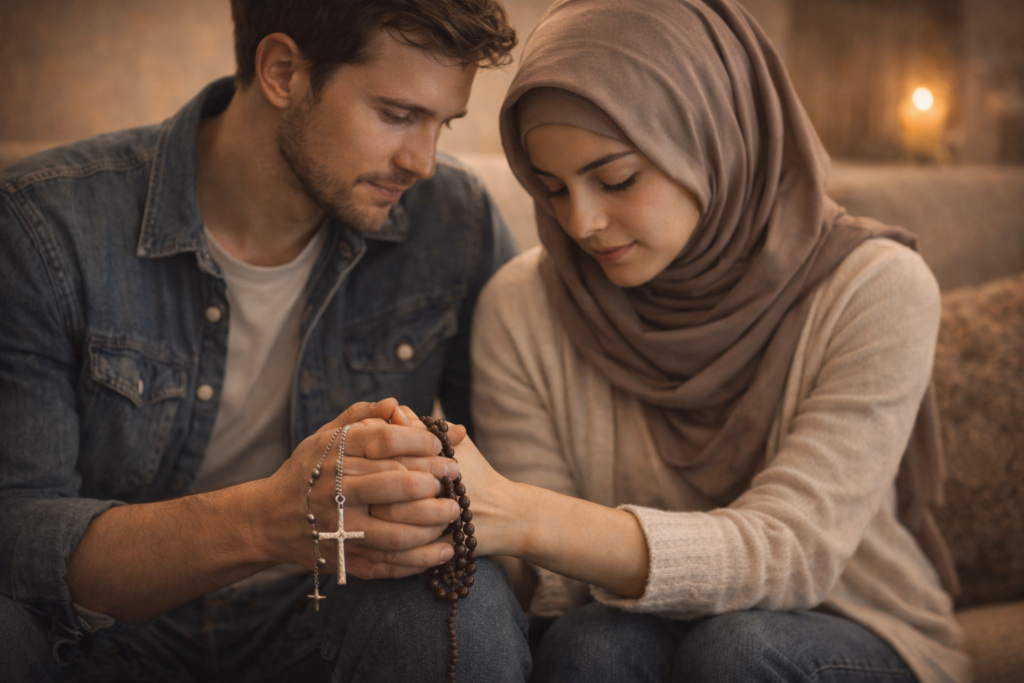
In the eyes of the Church, not all interfaith marriages are the same. Depending on your partner’s religious background, the requirements differ slightly. It is important to know the correct terminology when speaking to your priest:
The biggest hurdle in interfaith marriages is rarely the wedding day itself—it is the years of parenting that follow. The Church advises caution because sharing your faith with your children is one of the primary duties of a Catholic parent.
When parents share the same faith, Sunday Mass, prayer, and moral teaching are unified. In an interfaith home, questions inevitably arise: “Why does Dad not come to Communion?” or “Mom says Jesus is God, but Dad says He is just a prophet.” These contradictions can lead to religious indifference in children, who may decide that if parents can’t agree, faith must not be that important.
To receive permission for an interfaith marriage, the non-Catholic spouse does not need to convert. The Church respects their conscience. However, the Catholic spouse must make a sincere declaration (and the non-Catholic spouse must be informed of it):
“I promise to do all in my power to preserve my faith and to have all children baptized and brought up in the Catholic Church.”
This doesn’t mean you will force a result (you cannot control the future), but it means you promise not to abandon your duty to share the light of Christ with your children, even if your spouse does not participate.
The Short Answer: In the secular world, when happiness fades, the marriage ends. In the Catholic Church, marriage is a covenant sealed by God, meaning it is worth fighting for even when it feels hopeless. Unless there is abuse (where safety is the priority), the Church calls spouses to view a crisis not as a signal to leave, but as a call to deeper conversion and “spiritual warfare” for their family.
When resentment builds up, our natural reaction is to complain about our spouse to others or to attack them directly. This rarely works. To save a marriage, you must shift the battlefield from the dining room table to prayer.
The first step is often the hardest: praying for your spouse, not against them. It is difficult to hate someone you are sincerely commending to God’s mercy every day. This doesn’t solve the practical problems immediately, but it softens the heart enough to make communication possible. If you are struggling to find the words, you might find comfort in our guide to Catholic Anxiety Relief: Prayers and Guidance, which can help calm the emotional storm before you attempt a difficult conversation.
Saving a marriage often requires outside help. It is important to distinguish between the two types of support available:
Sometimes, one spouse is fighting for the marriage while the other has checked out. This is an incredibly lonely place to be. It is easy to fall into despair or believe that God has abandoned you.
In these moments, you need immediate spiritual support. You do not have to wait for a counseling appointment to get things off your chest.
Is your marriage hanging by a thread? Before you make a decision you can’t take back, speak to a compassionate listener. Talk to a Priest Online right now to receive encouragement, prayer, and guidance on your next step.
Questions to Ask a Priest Before Getting Serious
The Short Answer: Many couples wait until they are already engaged to start asking the hard questions during “Pre-Cana” (marriage preparation). This is often too late. A priest can help you identify “deal-breakers” early in the relationship, saving you from a heartbreaking separation later.
The most common reason for Catholic marriages to be declared null (annulled) later is a lack of openness to children. In a secular relationship, saying “I don’t want kids right now” is a preference. In a Catholic marriage, permanently excluding children invalidates the vows. Before you buy a ring, you must ask: “Are we both truly willing to accept children lovingly from God?” If one of you is hesitant or strictly against it, this is a spiritual emergency. You might want to read our thoughts on Catholic Parenting Advice Online to understand what this vocation actually looks like before you commit to it.
Love is not enough to sustain a household; you need a shared vision. A priest will often ask you practical questions that might feel unromantic but are vital for survival:
If you are scared to ask these questions to your partner because you are afraid of the answer, that is a sign you need courage.
Practice the Conversation First If you are nervous about discussing these heavy topics with your boyfriend or girlfriend, or if you don’t know how to phrase your concerns, try a “practice run.” You can ask our AI Priest specifically: “How do I tell my boyfriend that I won’t move in with him?” or “How do I ask my girlfriend about her debt?” to get a script that is charitable yet firm.
Navigating relationships in 2025 is difficult. The culture tells you to seek pleasure and avoid commitment, while the Church calls you to sacrificial love and lifelong fidelity. It is a harder path, but it is the only one that leads to true peace and a legacy that outlasts you.
Whether you are single and praying for a spouse, navigating the complexities of an interfaith relationship, or fighting to save a marriage that seems broken, remember that you are never truly alone. The Sacraments give you the grace to love beyond your human capacity.
Do you need someone to talk to right now? If your heart is heavy with relationship worries, don’t carry that burden by yourself. Talk to a Priest Online Now Start a confidential, judgment-free conversation and find the spiritual clarity you need to move forward in love.