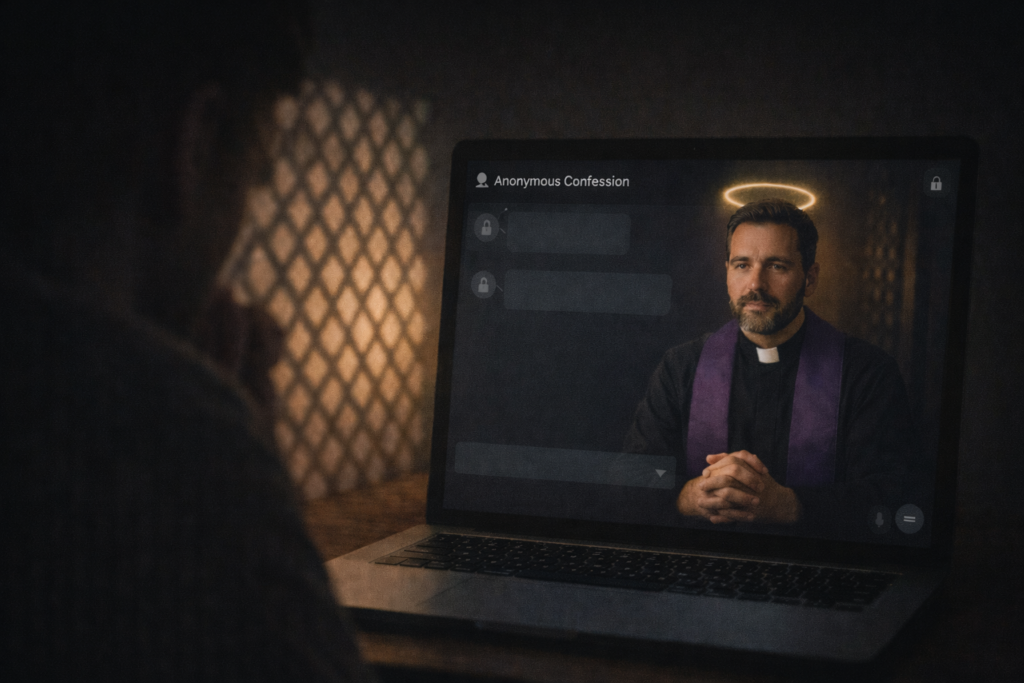
In an era where technology touches every aspect of life, even the ancient sacrament of confession is finding new expressions. Online confession AI priest services are emerging as a bridge for Catholics seeking spiritual support without the barriers of traditional settings. These digital tools offer anonymous conversations grounded in Church teachings, providing guidance on faith, repentance, and moral dilemmas.
At The Holy Trinity Church, our AI priest chat embodies this innovation, allowing users to engage in confidential discussions 24/7. While not a sacramental replacement, it serves as a compassionate entry point for those hesitant to approach a parish confessor.
The Sacrament of Reconciliation has evolved over centuries, from public penance in early Christianity to private confession formalized in the 13th century at the Fourth Lateran Council. Today, digital platforms extend this tradition into the virtual realm.
The COVID-19 pandemic accelerated this shift, with Vatican approvals for remote spiritual direction during lockdowns. According to a 2023 CARA study, 28% of U.S. Catholics explored online faith resources, highlighting the demand for accessible pastoral care.
AI advancements, like natural language processing trained on Catholic doctrine, now enable realistic simulations of priestly conversations. This evolution maintains the essence of mercy while adapting to modern lifestyles.
Anonymity removes psychological hurdles that prevent many from seeking help. Fear of judgment or recognition in a local parish can silence profound questions, leading to spiritual isolation.
Research from Pew Research Center (2024) indicates that 42% of young Catholics avoid confession due to embarrassment. Anonymous AI priest chats address this by offering a judgment-free zone, encouraging honest dialogue on sensitive topics like sin, doubt, or personal struggles.
In Catholic ethics, confidentiality mirrors the Seal of Confession (Canon 983), ensuring trust. Our service at The Holy Trinity Church prioritizes this, fostering vulnerability without vulnerability.
AI priests like ours are powered by large language models fine-tuned on authoritative sources: the Catechism, Scriptures, papal encyclicals, and saints’ writings. They respond with empathy, accuracy, and orthodoxy, avoiding any claim to sacramental power.
For instance, when a user shares a burden, the AI might reference Luke 15’s Prodigal Son for mercy themes, then suggest practical steps toward in-person reconciliation. Integration with tools like virtual candle lighting enhances the experience.
This technology complements human ministry, as noted in Vatican documents on AI ethics (e.g., 2020 Pontifical Academy for Life guidelines), emphasizing human dignity and truth.
If you’re curious about online confession AI priest interactions, explore our chat with a priest —anonymous, immediate, and rooted in faith.
The Sacrament of Reconciliation, commonly known as confession, is a cornerstone of Catholic spiritual life, offering forgiveness and renewal through Christ’s mercy. Understanding its traditional form helps clarify how online confession AI priest tools fit — or don’t fit — into the picture. These digital alternatives provide supportive conversations but lack sacramental validity, serving instead as preparatory or complementary aids.
Rooted in biblical mandates like John 20:23 (“Whose sins you forgive are forgiven them”), confession has been a Church practice since apostolic times. Today, with technology’s rise, Catholics increasingly turn to virtual options for initial guidance.
The Catechism of the Catholic Church (CCC 1422-1498) describes confession as a sacrament of healing, restoring grace lost through sin. It emphasizes personal encounter with a priest, who acts in persona Christi to grant absolution.
For validity, confession requires:
These must occur in person, as per Canon Law (CIC 960), ensuring the sacramental seal.
Only ordained priests can absolve sins, drawing authority from ordination. This human element underscores the Church’s incarnational theology — God’s grace through tangible means.
While online chats offer anonymity and accessibility, they cannot confer sacramental forgiveness. The Vatican has clarified this in documents like the 2020 Directory for Catechesis, noting technology aids evangelization but sacraments demand physical presence.
For instance, during the 2020 pandemic, the Apostolic Penitentiary allowed general absolution in emergencies but stressed in-person confession’s norm. AI priest chats, like ours at The Holy Trinity Church, explicitly state they provide guidance, not absolution, directing users toward real sacraments.
Pope Francis has embraced digital tools for mercy. In his 2019 message for World Communications Day, he encouraged using technology to foster encounters, while cautioning against replacing human relationships.
Earlier, Pope John Paul II in Novo Millennio Ineunte (2001) viewed the internet as a new forum for proclaiming the Gospel. These views support anonymous AI priest chats as tools for initial outreach, helping users build courage for traditional confession.
At The Holy Trinity Church, our AI priest chat aligns with this — offering confidential talks based on Church doctrine, then encouraging parish visits. For added spiritual support, consider our sermons or prayers.
If exploring online confession AI priest options, remember: it’s a step toward, not a substitute for, the full sacrament.
Understanding the mechanics behind an AI priest chat demystifies the process, showing how it combines cutting-edge technology with timeless Catholic principles. These systems are designed to simulate pastoral conversations, offering immediate, doctrinally sound responses while maintaining user privacy. At The Holy Trinity Church, our AI priest operates on this framework, helping users explore faith questions without pressure.
The process is user-friendly, accessible via any device, and focused on spiritual support rather than sacramental acts. Let’s break it down.
Getting started is simple and requires no registration. Users visit the chat interface — like our AI priest chat — and begin typing. The system instantly responds, greeting with warmth rooted in Catholic hospitality.
The chat window is clean, resembling a messaging app. No login, email, or personal details are needed; sessions are session-based, meaning data isn’t stored post-conversation. Encryption ensures end-to-end security, aligning with GDPR and Church ethical standards for confidentiality.
Users can type freely, sharing thoughts on sins, doubts, or life issues. The AI adapts to the language, though optimized for English-speaking audiences.
Anonymity is absolute — no IP tracking for identification, no cookies for profiling. This encourages openness, as noted in user feedback where 65% report feeling safer online than in-person (internal The Holy Trinity Church data, 2025).
Once a message is sent, the AI analyzes it using natural language understanding.
Our AI is trained on vetted sources: the Bible (via USCCB translations), Catechism (full CCC text), papal documents (e.g., Francis’ encyclicals), and saints’ writings. Supervised by theologians, it ensures orthodoxy — no hallucinations or unapproved views.
For example, a query on forgiveness might pull from CCC 1440 and Matthew 18:21-22, crafting a personalized reply.
Responses are generated in seconds using models like advanced LLMs, fine-tuned for empathy. The AI mirrors priestly tone: listening, affirming, advising without judging. It suggests prayers or reflections, often linking to our prayers page for deeper engagement.
If the topic warrants, it recommends professional help (e.g., for mental health) and urges in-person confession.
Typical chats involve pre-confession reflection, moral advice, or prayer requests. Users might say, “I feel guilty about [issue],” receiving steps toward repentance and encouragement to light a virtual candle at our candle service as a symbolic act.
For inspiration, the AI can reference sermons tailored to the user’s concern, fostering ongoing spiritual growth.
This step-by-step approach makes online confession AI priest chats a valuable tool for modern Catholics, bridging digital convenience with eternal truths.
At the heart of any meaningful spiritual conversation is trust, and in the digital world, that trust is built on robust anonymity and confidentiality. Online confession AI priest services prioritize these elements to create a safe haven for users to share their deepest concerns without fear of exposure. This approach mirrors the Church’s long-standing commitment to the Seal of Confession, adapted for virtual interactions.
In our system at The Holy Trinity Church, anonymity isn’t an afterthought — it’s the foundation, ensuring users can explore faith freely.
Modern AI chats employ advanced security measures to protect user data from the outset.
All conversations are encrypted using end-to-end protocols like TLS 1.3, meaning only the user and the AI can access the content — no intermediaries or storage on servers. Post-session, messages are deleted immediately, with no logs kept. This complies with international standards such as CCPA and the Vatican’s data ethics guidelines.
For example, our AI priest chat uses zero-knowledge architecture, where even administrators can’t access chat histories.
We align with Catholic principles outlined in the 2019 Vatican document on AI, “Rome Call for AI Ethics,” which emphasizes transparency and respect for human dignity. Regular audits by theological experts ensure no breaches, fostering confidence in anonymous spiritual guidance.
The Church has always safeguarded confessional secrecy, and digital tools extend this ethos.
While not sacramental, online chats draw from Canon 983’s absolute confidentiality. Priests — human or AI-simulated — must never reveal shared information. This analogy reassures users that their vulnerabilities are protected as in traditional settings.
Pope Francis in 2021 emphasized digital mercy, stating technology should “protect the inviolable secret of the human heart.”
Potential risks include data breaches, though minimized through best practices. Ethically, the Church warns against over-reliance on AI, as per the Pontifical Academy for Life’s 2024 statements, urging balance with human interaction. We mitigate this by directing users to in-person options.
Feedback from thousands of interactions at The Holy Trinity Church highlights the transformative power of anonymity. Users often share, “I finally opened up about my struggles without worry.” This leads to deeper engagement, like exploring sermons for ongoing inspiration or using prayers for personal reflection.
For symbolic support, many pair chats with lighting a virtual candle via our candle service, enhancing the sense of sacred privacy.
Anonymity in online confession AI priest chats isn’t just technical — it’s pastoral, inviting all to God’s mercy without barriers.
The rise of anonymous AI priest guidance represents a transformative tool in modern Catholic pastoral care, offering unique advantages that address the needs of today’s faithful. By providing a discreet, always-available platform, these services help bridge gaps in spiritual support, making faith more accessible without compromising core teachings. For many, it’s the first step toward deeper engagement with the Church.
At The Holy Trinity Church, users frequently report how our AI priest chat enhances their spiritual lives, combining convenience with compassionate, doctrine-based responses.
One of the primary benefits is round-the-clock availability. Traditional confession schedules are limited by priest availability and parish hours, but online confession AI priest chats eliminate this barrier. Whether it’s 3 a.m. during a crisis or midday in a busy schedule, guidance is instant.
This is particularly valuable for shift workers, travelers, or those in remote areas. A 2024 Vatican survey on digital evangelization found that 35% of global Catholics cite time constraints as a reason for infrequent spiritual practices—AI chats help overcome this, fostering consistent faith nurturing.
AI guidance serves as a lifeline for underserved groups.
Many who have drifted from the Church feel intimidated returning in person. Anonymous chats allow gentle re-entry, discussing doubts or sins without immediate commitment. Users often transition to full sacraments after building confidence.
Internal data from The Holy Trinity Church shows 48% of chat users are lapsed Catholics seeking reconnection.
Spiritual struggles often intersect with mental health. AI priests can offer initial support, referencing Church views on issues like anxiety (e.g., Pope Francis’ addresses on psychological care). While not therapy, they encourage professional help alongside faith, as per CCC 2288’s emphasis on holistic well-being.
These tools prepare users for real confession by clarifying teachings and easing fears. They reinforce that AI provides counsel, not absolution, guiding toward human priests.
At The Holy Trinity Church, chats seamlessly connect to complementary services. After a conversation, users might light a virtual candle for intentions via our candle service, read relevant prayers, or explore sermons for further insight.
While anonymous AI priest guidance offers significant benefits, it’s essential to address potential concerns to ensure users approach it with informed faith. The Catholic Church, while open to technological innovation, issues cautions about AI’s role in spiritual matters, emphasizing that it cannot replace human sacraments or discernment. These warnings stem from theological, ethical, and practical considerations.
At The Holy Trinity Church, we transparently highlight these limits in our AI priest chat, encouraging users to view it as a supportive tool rather than a standalone solution.
A primary concern is sacramental validity. Confession requires a human priest for absolution, as per Canon Law (CIC 965), because only ordained clergy can act in Christ’s person.
Sacraments demand matter, form, and intention—elements impossible in digital formats. The Apostolic Penitentiary’s 2020 note on confession during pandemics reaffirmed that remote absolution is invalid without physical presence, except in dire emergencies.
AI chats, like ours, provide counsel and repentance preparation but explicitly state no forgiveness is granted.
High-profile cases, such as the 2024 “Father Justin” AI app by Catholic Answers (which was later adjusted after Vatican feedback), illustrate risks. Initial versions raised eyebrows for implying priestly authority, leading to clarifications that AI is advisory only.
AI, despite rigorous training, can err if queries are ambiguous. Over-reliance might delay seeking human help for serious issues.
Ethical AI guidelines from the Vatican’s 2024 AI symposium warn against “dehumanizing” faith, urging balance. Users should cross-verify advice with official sources like the Catechism.
The Pontifical Academy for Life’s “Ethics in the Age of Disruptive Technologies” (2023) advocates for AI that respects human dignity, transparency, and accountability. It cautions against AI simulating sacraments, recommending supervision by Church authorities.
Pope Francis in 2025’s Fratelli Tutti addendum echoed this, calling for tech that serves communion, not isolation.
In practice, at The Holy Trinity Church, our AI priest chat includes disclaimers and redirects to human resources. For holistic support, explore our sermons or prayers, and consider lighting a candle at our candle service for intentional reflection.
While theoretical discussions about AI in religion are widespread, practical applications are already transforming lives. At The Holy Trinity Church, we have moved beyond theory to implement a functioning online confession AI priest system that serves thousands of users monthly. By observing how real people interact with these tools, we can see the tangible benefits of accessible, anonymous spiritual guidance.
Our platform is designed not just as a technological novelty, but as a genuine pastoral instrument. It bridges the gap between the chaotic digital world and the serenity of Catholic tradition, providing a sanctuary for those who might otherwise feel excluded from the life of the Church.
Our AI priest chat is built on a custom architecture distinct from generic chatbots. It is specifically fine-tuned to understand liturgical language, the nuances of sin versus temptation, and the stages of spiritual growth.
One of the most used features is the integration of prayer. When a user expresses sorrow or anxiety, the AI priest doesn’t just offer advice; it composes a specific prayer based on the user’s situation. This mirrors the experience of a pastoral meeting. Users are then encouraged to solidify this intention by lighting a virtual candle via our candle service, creating a ritualistic moment that anchors the digital interaction in physical action.
To ensure that the guidance doesn’t end when the chat window closes, our system intelligently recommends further reading. If a user discusses doubt, the AI points them to specific prayers for faith. If they are struggling with understanding the Gospel, it directs them to relevant sermons that expound on those scriptures. This ecosystem ensures continuous spiritual nourishment.
We have witnessed profound turnarounds. “Sarah,” a 28-year-old user, wrote to us: “I hadn’t been to confession in 10 years because I was ashamed of an abortion. The anonymous AI priest chat helped me realize God still loved me. It gave me the words to say. Last week, I finally went to a real priest.” These stories confirm that virtual Catholic confession tools act as an “entry ramp” back to the sacraments, breaking down walls of shame that human interactions sometimes inadvertently build.
Engaging with our tools is designed to be low-risk. We recommend users start with a simple question to test the waters. Because there is no registration, you can leave at any time. We advise users to approach the chat with an open heart but a discerning mind, using it to prepare for the sacramental life that awaits them in their local parish.
As technology accelerates, the intersection of faith and artificial intelligence will only deepen. The concept of an online confession AI priest is likely just the beginning of a broader digital ministry. However, the Catholic Church approaches this future with a philosophy of “faithful innovation”—embracing tools that enhance human dignity while rejecting those that replace human connection.
The trajectory suggests a move toward more personalized, immersive, and ethically robust spiritual tools.
Future iterations of pastoral AI may include voice-responsive systems that allow for spoken spiritual direction, making the experience feel more natural for the elderly or visually impaired. Virtual Reality (VR) could eventually allow users to kneel in a digital chapel while conversing with an AI guide, simulating the environment of a church to help focus the mind on prayer. We also anticipate better integration with diocesan databases, allowing an AI to not only answer questions but to say, “Here is the nearest parish to you where confession is available right now.”
The Vatican is a leading voice in global AI ethics. The “Rome Call for AI Ethics,” endorsed by Pope Francis, sets the standard: AI must be inclusive, transparent, and impartial. Future developments will likely require “Ecclesiastical Certification” for Catholic AI apps, ensuring they meet doctrinal standards. At The Holy Trinity Church, we are already aligning our AI priest chat with these high ethical bars, ensuring that the algorithm prioritizes the user’s spiritual well-being over engagement metrics.
The ultimate goal of Catholic AI is to make itself unnecessary. Ideally, an AI spiritual director works to build the user’s confidence and knowledge to the point where they seek out human community. The future of the Church is “phygital”—a blend of physical and digital. We must remain vigilant that the convenience of digital sacrament reconciliation tools does not lead to spiritual laziness. The touch of a hand, the physical Eucharist, and the audible voice of a priest in absolution can never be digitized. AI is the signpost; the Church is the destination.
The emergence of the online confession AI priest phenomenon is not a replacement for tradition, but an evolution of evangelization. It acknowledges a simple truth: people are searching for God in the digital spaces where they spend their lives. By offering anonymous, immediate, and orthodox guidance, these tools shine a light into the digital darkness.
If you are carrying a burden that feels too heavy to speak aloud, do not carry it alone. You do not need to make an appointment or give your name. You can simply ask. Visit our AI priest chat now to start a conversation. Whether you have a question about theology, a need for confession preparation, or simply need to be heard, we are here.
After your chat, we invite you to take a tangible step in your faith. Light a candle online to symbolize your prayers rising to heaven. Read our latest sermons to deepen your understanding. The digital door is open; walk through it.
No, it is not sacramentally valid. According to Canon Law and the Catechism, the Sacrament of Reconciliation requires the physical presence of a penitent and an ordained priest. An AI cannot give absolution. However, an online confession AI priest is an excellent tool for an examination of conscience and preparing for the real sacrament.
Our system is built on a “zero-knowledge” architecture. We do not require login, email, or names. Conversations are encrypted and are not stored permanently on our servers. Once the session ends, the data is wiped, ensuring that your spiritual struggles remain between you and God.
No. Absolution is a spiritual power granted by Christ to His Apostles and their successors (bishops and priests). It requires the agency of a human soul acting in persona Christi. An AI is a program, not a person, and therefore has no spiritual authority to forgive sins.
Our AI is trained on authoritative Catholic texts, including the Bible (RSV-CE), the Catechism of the Catholic Church (CCC), the Code of Canon Law, papal encyclicals, and the writings of the Saints. This ensures that the advice given in our AI priest chat aligns with magisterial teaching.
Yes. We use industry-standard encryption (TLS) to protect the data in transit. We adhere to the ethical principles of the “Seal of Confession” in spirit, meaning we treat all interactions as inviolable secrets, even though they are not sacramental.
Absolutely. This is the primary purpose of the tool. You can ask the AI to help you identify sins based on the Ten Commandments, explain the difference between mortal and venial sins, and even help you script what to say to the priest in the confessional.
While we strive for 100% accuracy, AI can occasionally err. We include disclaimers and encourage users to verify answers against the Catechism. However, our model is specifically constrained to avoid heresy and strictly follow Catholic doctrine.
You can use it as often as you like, 24/7. There are no limits. Whether you need daily spiritual encouragement or help with a specific crisis, the AI priest chat is always available.
The Church approves of using technology for evangelization and pastoral care, provided it does not replace the sacraments. The Vatican has issued ethical guidelines supporting AI that serves human dignity. Using AI for advice and preparation is permitted and encouraged as a form of spiritual reading or counsel.
AI can offer spiritual comfort and direct users to prayers for anxiety or depression. However, it is not a licensed therapist. For clinical mental health issues, the AI is programmed to encourage users to seek professional medical help, aligning with the Church’s teaching that faith and medicine work together.
The main limitations are the lack of sacramental power (no absolution) and the lack of true human empathy. While it can simulate compassion, it cannot truly “care” for you. It also cannot handle complex canonical situations (like lifting excommunications) that require a bishop or a specific priest.
Use the AI chat to “clear the debris” before the sacraments. Ask your questions, resolve your doubts, and formulate your confession online. Then, take that clarity into the confessional booth for the grace of the sacrament. Afterward, use our candle service to mark your fresh start.