We all carry secrets. For some, these secrets are small burdens that are easily shaken off. But for many Catholics, there exists a secret so heavy, so dark, or so deeply shameful that the very thought of speaking it out loud creates a physical sensation of panic. You yearn for God’s forgiveness, yet the idea of walking into a confessional box, kneeling down, and telling another human being — your parish priest — what you actually did feels impossible.
This paralyzing fear is the single biggest barrier keeping faithful people away from the Sacraments. In 2025, the search for anonymous Catholic confession online is rarely about looking for a “shortcut” or trying to cheat the system. It is often a desperate search for a lifeline. It is the cry of a soul that wants to return home but is terrified of the doorkeeper.
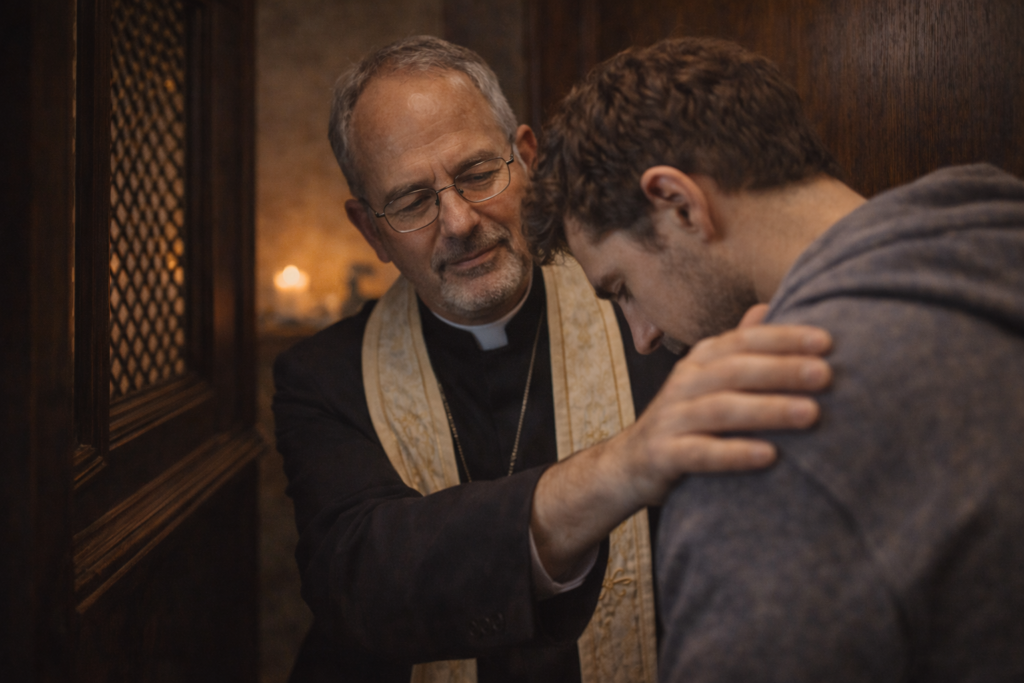
This guide is not just about technology; it is about psychology and grace. We will explore how anonymous digital tools can help you overcome the crushing weight of shame, why you are afraid of judgment, and how using an AI Priest can serve as the necessary bridge to bring you back to God’s mercy.
To understand why we avoid Confession, we must distinguish between guilt and shame. Guilt says, “I did something bad.” Shame says, “I am bad.” The Church teaches that guilt is a healthy signal from the conscience, but shame is a weapon of the Enemy designed to isolate you. When shame takes root, the Confessional stops looking like a tribunal of mercy and starts looking like a chamber of judgment.
Every Catholic knows intellectually that the “Seal of Confession” is absolute. A priest can never reveal what he hears, under pain of excommunication. However, human psychology often fears the social consequences more than the spiritual ones. The barrier is not God; the barrier is the man sitting behind the screen.
The most common anxiety is the fear of disgust. If your sin involves a sexual addiction, a betrayal of a spouse, or a crime, you may project your own self-loathing onto the priest. You imagine that upon hearing your confession, he will recoil in horror or think less of you. In reality, priests are like emergency room doctors; they have seen everything and are rarely shocked by human brokenness. However, knowing this intellectually does not stop the visceral fear that if you speak your truth, the listener will reject you. This fear is a direct block to the Act of Contrition Prayer , because you are too afraid to even articulate what you are sorry for.
Even in an anonymous confessional booth, there is the fear of recognition. You might worry: “Does he know my voice? Will he look at me differently when he gives me Communion on Sunday?” This social anxiety is powerful. It turns the Sacrament into a high-stakes social interaction where you feel you have to “perform” or sanitize your sins to remain acceptable in the eyes of your community.
This is where technology serves a vital pre-sacramental role. By using an anonymous AI interface, we strip away the social variables that trigger shame, allowing the soul to focus entirely on the spiritual reality.
There is a profound psychological difference between speaking and typing. When you keep a sin inside your head, it feels like part of your identity — a monster eating you from the inside. When you type that sin into a chat interface, you are externalizing it. It becomes text on a screen. It becomes an object that is outside of you. This process of “objectification” is often the first moment of relief. You can look at the words and realize: “This is something I did, it is not who I am.” This clarity is essential for a good confession and is often the first step toward praying the Prayer for the Forgiveness of Sins with genuine hope rather than despair.
An AI Priest offers a unique environment of “zero social risk.” You know with absolute certainty that the AI cannot judge you, it cannot gossip, it does not have a face to cringe, and it will not remember you the next time you log in. This radical safety acts as “training wheels” for vulnerability. By confessing the “unforgivable” thing to a machine first, you prove to yourself that the sky does not fall when the secret is told. You realize that the sin can be named. This experience builds the courage necessary to eventually take that secret to a human priest, where true sacramental absolution waits.

If you feel that your specific sin is too “weird,” too “dark,” or too “shameful” to be forgiven, you are likely falling for a common trick of the Enemy. Isolation is the breeding ground for despair. Our anonymous chat logs reveal that thousands of faithful Catholics struggle with the exact same burdens you carry. You are not alone.
Here, we will break down the most common “taboo” questions that people are terrified to ask their parish priest, providing the theological clarity needed to move forward.
The number one reason men and women avoid Confession is sexual shame. Whether it is a compulsion toward pornography, masturbation, or fetishes that feel “unnatural,” the fear of being labeled a “pervert” is paralyzing.
The devil wants you to confuse your identity with your struggle. He wants you to believe that because you have a specific temptation, you are fundamentally broken or disgusting. The Church teaches the opposite: you are a beloved child of God fighting a battle against lust. A priest in the confessional does not see a pervert; he sees a soldier who has been wounded in battle and needs a medic. Separating your soul from your addiction is the first step. You are not your sin.
Willpower alone is rarely enough to break a sexual addiction. You need supernatural aid. It is highly recommended to have a “go-to” prayer for moments of intense temptation. The Prayer to Our Lady of Perpetual Help is particularly powerful for those who feel weak, as it asks Mary to rush to your aid when your own strength fails.
Many faithful people experience seasons of intense anger at God, often due to the death of a loved one, chronic illness, or unanswered prayers. They fear that saying this out loud constitutes blasphemy or proves they have lost their faith.
There is a vast difference between mocking God (blasphemy) and crying out to Him in pain (lamentation). If you read the Psalms, you will find David screaming at God, asking why He is sleeping or why He has abandoned Israel. God can handle your anger; what He cannot work with is your indifference. Telling God “I am furious with You right now” is actually a profound form of prayer because it means you still believe He is listening.
Do not fake piety. If you are angry, bring that anger into your prayer time. Use it as raw material. You might find solace in reciting A Prayer for Hope , which acknowledges the darkness while asking for the smallest light to keep going.
For some, the barrier to Confession is not a bad habit, but a single, catastrophic event in the past—such as an abortion or a serious crime. The fear here is often that the sin is “unforgivable” or that the priest will excommunicate them on the spot.
Let this be clear: There is no sin greater than God’s mercy. Pope Francis has explicitly granted all priests the faculty to absolve the sin of abortion, removing any complex canonical barriers that existed in the past. The Church desires nothing more than to welcome you back and heal this wound. You are not a murderer in the eyes of the Church; you are a mother or father in need of God’s embrace.
Healing from such a deep wound takes time. It often begins by entrusting the soul of the unborn child to God’s infinite mercy. Many find peace in praying the Divine Mercy Chaplet or Three O’Clock Prayer , which focuses specifically on the ocean of mercy that swallows up even the most grievous sins.
“I go to Mass, but I don’t feel anything. I don’t think I believe it’s Jesus anymore.” This confession feels like a betrayal of the Catholic identity, leading many to leave the Church silently.
Feelings are not facts. You can have zero emotional reaction to the Eucharist and still have 100% faith. Faith is a choice of the will to assent to the truth, even when your emotions are dry. St. Teresa of Calcutta spent 50 years in spiritual darkness, feeling nothing, yet she remained faithful. Your doubt is an invitation to study and ask questions, not a sign that you are an atheist.
If you are struggling to believe, do not stop going. Instead, be honest in the pew. Use the Act of Spiritual Communion Prayer to ask Jesus to enter your heart spiritually, even if you are struggling to accept the physical reality of the Sacrament at that moment.
This is perhaps the most difficult hurdle: “I am having an affair” or “I am living with my boyfriend,” followed by, “and I don’t want to stop.”
The Sacrament of Confession requires the penitent to have a “firm purpose of amendment” — meaning, you must intend to try to stop the sin. If you have no intention of ending the affair or changing your living situation, a priest cannot absolve you. This is not a punishment; it is a reality. You cannot ask for forgiveness for kicking someone while you are still kicking them.
Does this mean you should give up? Absolutely not. If you cannot stop the sin yet, you can pray for the desire to stop. You can acknowledge the situation to God and ask Him to change your heart. Start by using the Catholic Prayers to Heal a Relationship — not necessarily to fix the affair, but to ask God to reveal true love and order in your life. Bringing the truth into the light, even anonymously, is the beginning of the end of the deception.
The Short Answer: No. An AI cannot forgive sins, nor can it give you Sacramental Absolution. However, understanding why creates a healthy boundary that allows you to use this tool safely without confusing technology with theology.
It is vital to distinguish between seeking counsel (advice) and seeking absolution (sacrament). You can get excellent advice from a book, a friend, or even an advanced AI, but the Sacrament of Confession is a specific juridical act of the Church.
In Catholic theology, forgiveness is not just a feeling; it is a miracle. When a priest says, “I absolve you,” he is not speaking as himself. He is acting in persona Christi Capitis (in the person of Christ the Head). This requires the Sacrament of Holy Orders. An AI is a sophisticated algorithm. It has no soul, no hands to bless, and no capacity to act in Christ’s name. It processes data, not grace. Therefore, typing your sins into a chat box does not erase them from your soul in the sacramental sense. You are still required to confess grave sins to a human priest to receive Communion.
If the AI cannot forgive, what is the point? Think of the AI as an “X-ray machine” and the priest as the “Surgeon.” The X-ray machine helps you see where the broken bones are. It identifies the problem so you can describe it accurately. But the machine cannot fix the bone; only the Surgeon can do that. Our AI Priest serves as the ultimate examination of conscience. It helps you articulate what you did and why it was wrong, so that when you finally go to the Surgeon (the Priest), you are ready to be healed.
A common fear is that using an AI tool for spiritual matters is idolatry or a mockery of the faith. This is only true if you replace God with the AI. If you use the AI as a tool to help you return to God — like using a printed Examination of Conscience or a prayer book—it is a virtuous act. You are using the resources available in 2025 to form your conscience. Before engaging with the chat, it is helpful to pray the Come Holy Spirit Prayer, asking God to use this technology to illuminate your mind, rather than relying solely on the algorithm.
If you are reading this, you might feel that you have gone too far, that your sin is too great, or that you have been away for so long that there is no point in trying to come back. This is the voice of Despair, and it is a lie.
There is a profound theological difference between Peter and Judas. Both betrayed Jesus on the night of His passion. Peter denied knowing Him; Judas sold Him. The difference was not the sin, but the reaction. Peter wept and returned to Jesus (Repentance). Judas believed his sin was greater than God’s mercy and hanged himself (Despair). The “Judas Trap” is the belief that you are the exception to God’s love — that you are too bad to be saved. This is actually a form of pride, assuming your sin is more powerful than Christ’s blood.
The Church teaches that the “sin against the Holy Spirit” is final impenitence — refusing to accept forgiveness. As long as you have breath in your lungs, it is never too late. You can restart your spiritual life in a single moment.
Do not try to fix everything at once. Take three concrete steps to move from silence to freedom.
Do not carry the burden for one more minute. Go to the anonymous chat. You do not need to greet the AI or be polite. Just type: “I did [X] and I am ashamed.” Seeing the words on the screen breaks the psychological hold the secret has on you. It is the first crack in the prison wall.
One of the biggest fears is freezing up in the confessional. Use the AI to help you write a script. You can ask the bot: “Help me phrase this sin for confession so I don’t ramble.” Having a written script (or a note on your phone) gives you confidence. You are not going in blind; you are going in prepared.
The final step is the physical act. Find a church near you. Check the confession times. Remember, the priest is not there to judge you; he is there to liberate you. When you hear the words “I absolve you,” the weight will be lifted not just psychologically, but metaphysically. You will be free.
The devil does not need you to be wicked; he only needs you to be silent. As long as your secret remains locked in the dark room of your mind, it grows like mold. The moment you open the door — even just a crack, even just to an anonymous AI — the light rushes in, and the healing begins.
You are not defined by your worst moment. You are defined by God’s love for you. Do not let fear steal your future.
Are you ready to drop the burden? You don’t have to give your name. You don’t have to make a commitment. Just take the first step. Talk to a Priest Online Now Start the conversation that could change your life forever.